
What Is a System Boiler and Is It Right for Your Home?
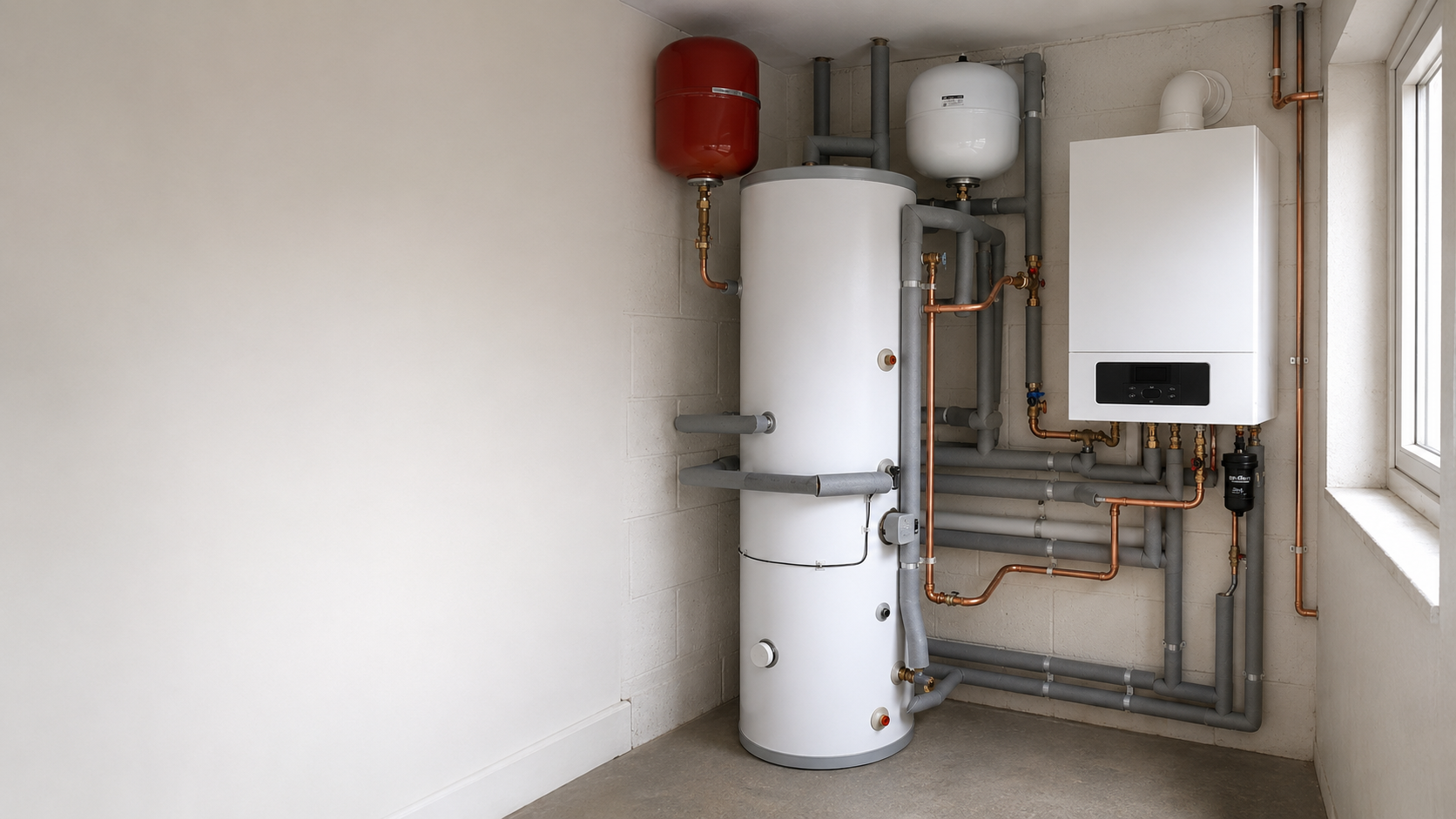
A system boiler heats your central-heating circuit and a separate hot-water cylinder. Unlike a combi, it stores a prepared volume of hot water for later use. Unlike many traditional open-vent systems, it normally contains key components such as the pump and expansion vessel inside the boiler and operates as a sealed system.
Its main advantage is capacity. A correctly designed cylinder can serve more than one hot outlet at the same time, making a system boiler particularly useful in family homes with multiple bathrooms.
System boiler at a glance
- Works with a separate hot-water cylinder
- Usually does not need a feed-and-expansion tank in the loft
- Can serve several hot-water outlets simultaneously
- Needs space for the cylinder
- Must be sized around heating loss, cylinder recovery and household demand
- Can provide an immersion-heater backup when the cylinder includes one
How does a system boiler work?
The boiler heats water in a sealed primary circuit. An internal pump circulates this water either through the radiators or through a coil inside the hot-water cylinder.
When the cylinder thermostat calls for heat, hot primary water passes through that coil. Heat transfers into the stored domestic water without the two supplies mixing. Once the cylinder reaches its target temperature, the controls stop the demand.
When somebody opens a tap, hot water leaves the cylinder and is replaced by cold water. In an unvented cylinder, incoming mains pressure drives the delivery to the outlets.
The boiler itself is only part of the design. Cylinder size, coil performance, controls, water supply, pipework and heat-up strategy all influence the finished result.
How is a system boiler different from a combi?
The key distinction is stored water.
| Feature | System boiler | Combi boiler |
| Hot-water cylinder | Required | Normally not required |
| Hot-water production | Heats and stores water | Heats water on demand |
| Simultaneous outlets | Better suited to multiple outlets | Limited by boiler and mains flow |
| Space requirement | Boiler plus cylinder | Compact single appliance |
| Hot-water backup | Cylinder may include immersion heater | No stored immersion backup |
| Running out of hot water | Possible until cylinder reheats | No stored volume, but flow is limited |
A combi is often attractive where space is tight and hot-water demand is moderate. A system boiler becomes more compelling when several people need hot water close together or at the same time.
How is it different from a regular boiler?
A regular, conventional or heat-only boiler also works with a hot-water cylinder, but a traditional installation may include a feed-and-expansion cistern in the loft and more external components.
A system boiler incorporates much of the sealed-system equipment within its case. This can simplify the installation and remove the need for a small heating feed tank, although the exact arrangement depends on the property.
Do not confuse the heating expansion arrangement with the domestic water supply. A vented hot-water cylinder may still use a cold-water storage cistern, while an unvented cylinder is supplied from the mains and includes its own safety and expansion provisions.
Vented and unvented cylinders
Vented cylinder
A vented cylinder is normally supplied from a cold-water storage cistern, often located in the loft. Outlet performance depends partly on the available head of water, so pumps may be used for some showers.
This arrangement can suit homes with an existing traditional system, but it uses loft space and may not provide mains-pressure performance without additional equipment.
Unvented cylinder
An unvented cylinder is fed directly from the incoming main. It can provide strong balanced hot-water performance when the main delivers adequate flow and dynamic pressure.
Because the stored water is pressurised, the cylinder includes specific safety devices and discharge arrangements. Installation and servicing require an engineer with the appropriate unvented-hot-water qualification as well as any registration required for the heat source.
Which homes suit a system boiler?
A system boiler is often well suited to:
- Homes with two or more bathrooms
- Families that use showers at similar times
- Properties with larger baths
- Homes already fitted with a good-quality cylinder
- Renovations where a dedicated airing cupboard or plant space is available
- Households that value an immersion-heater backup
- Systems incorporating controls for timed hot-water storage
It is not reserved for mansions. A smaller house with unusually high simultaneous hot-water demand may benefit more than a large property occupied by one person.
How large should the hot-water cylinder be?
Cylinder sizing should reflect real usage rather than guesswork.
The designer should consider:
- Number of occupants
- Baths and their usable capacity
- Number and type of showers
- Peak simultaneous demand
- Desired recovery time
- Available boiler output
- Cylinder coil rating
- Incoming main performance for an unvented cylinder
- Space, access and structural support
- Preferred hot-water schedule
An oversized cylinder occupies more space and stores more hot water than necessary. An undersized cylinder can run out during peak use. The correct balance provides usable capacity with a sensible recovery time.
What boiler output does a system boiler need?
System boilers often have lower headline outputs than high-powered combis because they do not have to raise mains water to tap temperature instantaneously.
Sizing should account for:
- The property’s design heat loss
- The output required to reheat the cylinder
- How the controls prioritise heating and hot water
- The boiler’s minimum modulation
- The cylinder coil’s permitted input
Simply adding a large allowance to the heating load can produce an oversized appliance that cycles unnecessarily. The boiler and cylinder should be selected as a matched system.
What happens when the stored hot water runs out?
Cold water entering the cylinder replaces the water used. If demand exceeds the stored capacity, outlet temperature eventually falls until the boiler reheats the cylinder.
Recovery time depends on cylinder volume, remaining water temperature, boiler output, coil performance and control strategy. Some controls can prioritise cylinder reheating temporarily so usable hot water returns quickly.
This is different from a combi. A combi does not empty a cylinder, but its instantaneous delivery is limited at every moment. A system boiler can release a higher short-term flow from storage, but that store is finite.
Is a system boiler efficient?
Modern system boilers use the same condensing principles as modern combis. Their real efficiency depends on installation and operation, including:
- Correct boiler sizing
- Appropriate radiator output
- Low return-water temperatures
- Weather or load compensation where suitable
- Hydraulic balancing
- Insulated primary pipework
- A well-insulated modern cylinder
- Sensible hot-water timing and temperature
A cylinder has standing heat loss, although modern products are well insulated. Some of that heat remains useful inside the home during colder months, but unnecessary storage and poorly insulated pipework should still be avoided.
Can a system boiler work with solar thermal?
Yes, when installed with a compatible twin-coil cylinder and suitable controls. One coil can accept heat from solar thermal collectors while the boiler uses the second coil to top up the cylinder when required.
This needs to be planned at design stage. A standard single-coil cylinder cannot simply accept an additional solar circuit without the necessary connections and controls.
Solar photovoltaic panels are different: they generate electricity. Surplus PV may sometimes be directed to an immersion heater through a compatible diverter, but this is separate from the boiler’s primary coil.
What space does a system boiler installation need?
The boiler may fit in a kitchen, utility room, garage or cupboard, subject to manufacturer instructions and a compliant flue and condensate route. The cylinder needs its own suitable location, commonly an airing cupboard or plant area.
An unvented cylinder is heavy when full. Access, supporting structure, maintenance clearances and the safety-discharge route must be assessed before installation.
Converting from a combi may require:
- New cylinder and primary pipework
- Changes to hot- and cold-water distribution
- Controls and motorised valves
- An immersion electrical supply
- Cylinder safety discharge pipework
- Alterations to cupboards or storage space
Conversely, replacing an existing system boiler and retaining a suitable cylinder may be relatively straightforward.
Common system-boiler mistakes
- Choosing the cylinder only by physical size
- Assuming static water pressure guarantees good flow
- Oversizing the boiler without considering modulation
- Failing to insulate primary pipework
- Poor positioning of controls and sensors
- Inadequate access for cylinder servicing
- Incorrect or compromised safety-discharge routing
- Keeping an old, inefficient cylinder without assessing its condition
- Ignoring water treatment and system cleanliness
Is a system boiler right for your home?
Choose based on the way the household uses hot water—not on a generic rule.
A system boiler may be the better choice when simultaneous demand and rapid bath or shower delivery matter more than saving the cylinder cupboard. A combi may still be preferable where space is limited and hot-water use is modest.
Enerus can assess the existing installation, water supply, heat demand, cylinder options and available space before recommending a boiler type. Explore our new boiler installation service or contact us to arrange a quotation.
Call: 0191 816 5305 or 01740 669 585
Frequently asked questions
Does a system boiler need a tank in the loft?
The sealed heating circuit normally does not need a feed-and-expansion tank. A vented hot-water cylinder may still need a cold-water storage cistern; an unvented cylinder normally does not.
Can a system boiler run two showers together?
A properly designed unvented-cylinder system often can, provided the cylinder, distribution pipework and incoming main can meet the combined flow.
Can I replace a combi with a system boiler?
Yes, but the conversion requires space for a cylinder and usually additional pipework, controls, electrics and—in the case of an unvented cylinder—a compliant safety-discharge route.
Can an immersion heater provide backup?
Many cylinders have an immersion heater. It can provide hot water if the boiler is unavailable, although reheating electrically may be slower or more expensive depending on the tariff.
Does a system boiler provide mains-pressure hot water?
It can when paired with an unvented cylinder and an adequate incoming main. A vented cylinder behaves differently and is normally supplied from a storage cistern.
Who can install an unvented cylinder?
The installer needs the appropriate competence for unvented hot-water systems. Gas work must also be carried out by an appropriately qualified Gas Safe registered engineer.
Helpful Links
- New boiler installation: https://www.enerushome.co.uk/new-boiler-installation/
- Maintenance and repair: https://www.enerushome.co.uk/maintenance-repair/
- Contact: https://www.enerushome.co.uk/contact/
- Learn: https://www.enerushome.co.uk/learn/
- Vaillant system boiler guide: https://www.vaillant.co.uk/advice/understanding-heating-technology/boilers/what-is-a-system-boiler/
- Worcester Bosch boiler types: https://www.worcester-bosch.co.uk/boiler-types
- Worcester Bosch boilers explained: https://www.worcester-bosch.co.uk/products/boilers/explained
- Gas Safe Register: https://www.gassaferegister.co.uk/boiler-engineer/
- Boiler Plus factsheet: https://assets.publishing.service.gov.uk/media/5b2cc1e2ed915d586e2d8fe9/Boiler_Plus_Factsheet_v3.pdf