
What Is a Combi Boiler? History, Sizes, Outputs and Uses
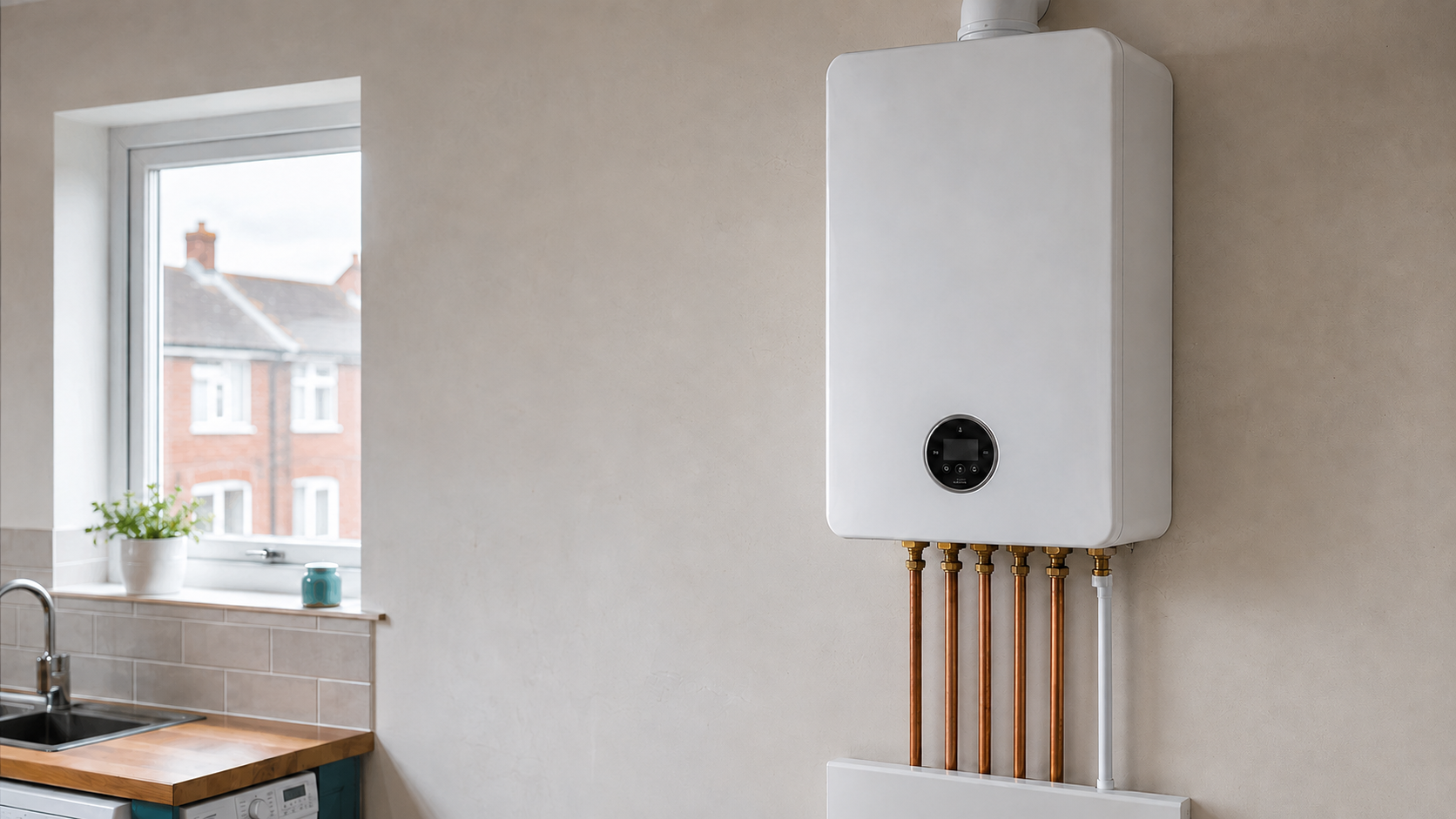
A combination—or combi—boiler provides central heating and hot water from one compact appliance. It does not normally need a separate hot-water cylinder or cold-water storage tank. Instead, it heats mains water as you open a hot tap.
That makes a combi a practical choice for many UK flats, terraces and family houses. It saves space and avoids storing a cylinder of hot water. However, its hot-water performance depends on the incoming mains supply and the boiler’s domestic-hot-water output, so it is not automatically the best solution for every home.
Combi boiler at a glance
- Provides heating and hot water from one appliance
- Heats tap water on demand
- Does not normally require a hot-water cylinder
- Works as a sealed, pressurised heating system
- Suits homes with moderate simultaneous hot-water demand
- Must be sized using both heating demand and hot-water requirements
Why is it called a combination boiler?
The name describes exactly what the appliance does. A combi combines the functions that older systems distributed across a boiler, circulating pump, expansion arrangement and separate hot-water storage system.
When the heating is running, hot primary water circulates through the radiators. When somebody opens a hot tap, the boiler prioritises domestic hot water. A diverter valve directs heat through a plate heat exchanger, where energy from the sealed primary circuit is transferred to fresh mains water without the two water supplies mixing.
This packaged approach is why a modern combi can be fitted in a kitchen cupboard, utility room or airing cupboard where the necessary clearances, flue route, condensate discharge and services allow.
A brief history of the combi boiler
Early central-heating installations typically used separate appliances and stored water. They often needed a boiler, hot-water cylinder, feed-and-expansion cistern and associated controls.
Manufacturers gradually brought those functions into more compact appliances. Vaillant describes its Combi-Geyser VCW 20—which combined heating and hot-water supply in a single unit—as the first of its kind. Combination boilers later became established in the UK as homes placed greater value on space, convenience and hot water without waiting for a cylinder to reheat.
The technology continued to progress:
More compact appliances
Pumps, valves, heat exchangers, controls and expansion vessels were integrated into increasingly tidy wall-mounted cases. Modern cupboard-fit models can be significantly smaller than earlier boilers, although installation clearances must always follow the manufacturer’s instructions.
Electronic ignition and modulation
Older boilers could rely on permanent pilot lights and relatively simple on/off operation. Modern appliances use electronic ignition and can reduce—or modulate—their burner output as demand falls. Good modulation helps a correctly designed system avoid unnecessary cycling during mild weather.
Condensing technology
Modern boilers recover additional heat from their flue gases. When return-water temperature is sufficiently low, water vapour in the products of combustion condenses inside the heat exchanger and releases useful latent heat.
The improvement is not simply a label on the casing. Radiator sizing, weather or load compensation, system balancing and sensible flow temperatures all affect how often the boiler operates in its most efficient condensing range.
Smarter controls
Time and temperature control are now a standard part of a compliant installation. Weather compensation, load compensation and suitable smart controls can vary boiler flow temperature rather than repeatedly running the appliance at maximum temperature.
England’s Boiler Plus standards set a minimum 92% ErP performance requirement for domestic gas-boiler installations and require time and temperature controls. A replacement combi installation also needs an additional energy-efficiency measure meeting the applicable standard.
How does a modern combi boiler work?
A combi has two distinct jobs.
Central heating
The burner heats water in the primary circuit. The internal pump sends it through the home’s radiators or other compatible heat emitters before it returns to the boiler.
The central-heating requirement is determined by the property’s design heat loss—not simply by counting bedrooms. A well-insulated three-bedroom house may require less heating output than a smaller, poorly insulated solid-wall property.
Domestic hot water
Opening a hot tap creates a flow through the boiler. The appliance detects this demand, fires the burner and transfers heat to the incoming mains water. Because the water is heated as it passes through, there is no stored volume to run out in the same way as a cylinder.
There is still a limit, however: the boiler can only raise a certain flow of water by a certain temperature. Running two showers or filling a bath while another hot outlet is open may divide the available flow and reduce performance.
Combi boiler size: what does the kW figure mean?
Boiler output is expressed in kilowatts (kW), but a combi can have different figures for central heating and hot water.
A model marketed as a “30kW combi” may provide around 30kW to domestic hot water while limiting central-heating output to a lower figure. This matters because hot water is often the factor that drives the headline combi size.
| Specification | What it tells you |
| Maximum heating output | The highest rate of heat supplied to the heating circuit |
| Minimum heating output | How far the appliance can modulate during low demand |
| Hot-water output | The power available to heat mains water instantaneously |
| Hot-water flow rate | Litres of hot water delivered per minute at a stated temperature rise |
| Dimensions | Whether the boiler and required clearances fit the proposed location |
As a real-world illustration, Worcester Bosch lists a Greenstar 4000 25kW combi with a 24kW central-heating output and a quoted hot-water flow rate of 9 litres per minute at a 40°C temperature rise. Higher-output Greenstar 8000+ combis are listed with flow rates of up to 15 or 16 litres per minute at the same stated rise. These are product examples rather than universal promises.
Flow rate matters as much as output
Homeowners often focus on boiler kW and overlook the incoming water supply.
Combi performance depends on:
- Incoming dynamic water pressure
- Available mains flow rate
- Pipe diameter, condition and restrictions
- The temperature of the incoming cold water
- The temperature requested at the outlet
- The number of outlets used simultaneously
Pressure and flow are not the same. A property can show reasonable static pressure but deliver inadequate flow when taps are opened. That is why a proper survey should test the supply rather than assume that a larger boiler will solve everything.
What size combi boiler does a home need?
Rules based only on bedroom or radiator count are useful for initial comparison, but they are not a final design.
A competent assessment should consider:
- Room-by-room or whole-property heat loss
- Number and size of radiators
- One or multiple bathrooms
- Bath size and preferred filling time
- Type and flow requirement of showers
- Incoming mains-water performance
- Likelihood of simultaneous hot-water use
- Available gas supply and pipe sizing
- Flue, condensate and boiler-location constraints
Avoid dramatically oversizing the heating side merely to obtain a higher hot-water flow rate. The selected appliance needs an appropriate modulation range and should be commissioned to suit the heating system.
Which homes suit a combi boiler?
A combi is often a strong option for:
- Flats and apartments
- Terraced and semi-detached houses
- Homes with one main bathroom
- Properties where cupboard or loft-tank space is valuable
- Households that rarely run several hot outlets together
- Replacements where an existing combi arrangement already performs well
It may also work in a larger property if the water supply and demand pattern are suitable. Property size alone does not decide the answer.
When might a combi not be the best choice?
Consider a system boiler or another stored-water arrangement where:
- Two or more showers are regularly used together
- A large bath needs a fast fill
- The household has high simultaneous hot-water demand
- The incoming main cannot deliver the required performance
- The property already has a modern, suitable hot-water cylinder
- Solar thermal or another stored-hot-water input is planned
A combi cannot independently improve a poor incoming main. Nor can its headline output guarantee strong performance at several outlets at once.
Advantages and limitations
| Advantages | Limitations |
| Compact, self-contained appliance | Hot-water output is finite |
| No cylinder or loft cistern normally required | Depends on mains flow and dynamic pressure |
| Hot water heated only when requested | Simultaneous outlets share available capacity |
| No stored hot water to deplete | No simple immersion-heater backup |
| Straightforward replacement where a combi already exists | Conversion from a traditional system can involve extensive pipework |
Choosing and installing a combi properly
The best boiler is not necessarily the largest or most expensive. It is the appliance that suits the home, water supply, heat loss, controls, system condition and budget.
Before installation, Enerus can assess the existing boiler and heating system, discuss hot-water use, check the proposed location and provide a clear fixed-price quotation. Installation must be carried out by an appropriately qualified Gas Safe registered engineer.
If you are considering a new combi in Northumberland or elsewhere in the North East, explore our new boiler installation service or contact Enerus for advice.
Call: 0191 816 5305 or 01740 669 585
Frequently asked questions
Does a combi boiler provide unlimited hot water?
It can continue heating water for as long as fuel and mains water are available, but it has a maximum flow rate. Several outlets used together divide that capacity.
Does a combi need a hot-water cylinder?
Normally, no. It heats mains water on demand. Some specialist hybrid or storage-combi products differ, so check the exact appliance.
Is a 30kW combi suitable for a three-bedroom home?
Possibly, but bedroom count is not enough to size it. Heating loss, hot-water flow, bathrooms, incoming main and modulation range should all be assessed.
Can a combi supply two showers?
It may supply two modest outlets if the mains and boiler can provide enough flow, but performance commonly falls when both are used. Homes with frequent simultaneous demand may be better served by stored hot water.
How long should a combi boiler last?
Manufacturers commonly suggest around 10–15 years for a good-quality, maintained boiler, although water quality, installation, usage and annual servicing affect its working life.
Does a new combi have to be Gas Safe installed?
Yes, where gas work is involved. Gas Safe Register states that anyone fitting, fixing or servicing a gas boiler must be Gas Safe registered.
Helpful Links
New boiler installation: https://www.enerushome.co.uk/new-boiler-installation/
Maintenance and repair: https://www.enerushome.co.uk/maintenance-repair/
Best combi boilers: https://www.enerushome.co.uk/best-combi-boilers-for-2025/
Contact: https://www.enerushome.co.uk/contact/
Gas Safe Register: https://www.gassaferegister.co.uk/boiler-engineer/
Vaillant heritage: https://www.vaillant.co.uk/about-us/our-heritage/
Vaillant combi guide: https://www.vaillant.co.uk/advice/understanding-heating-technology/boilers/what-is-a-combi-boiler/
Worcester Bosch boilers explained: https://www.worcester-bosch.co.uk/products/boilers/explained
Worcester Bosch water-pressure guidance: https://www.worcester-bosch.co.uk/support/troubleshooting/faqs/all-faqs/how-could-mains-water-pressure-affect-my-combi-boiler
Boiler Plus factsheet: https://assets.publishing.service.gov.uk/media/5b2cc1e2ed915d586e2d8fe9/Boiler_Plus_Factsheet_v3.pdf