
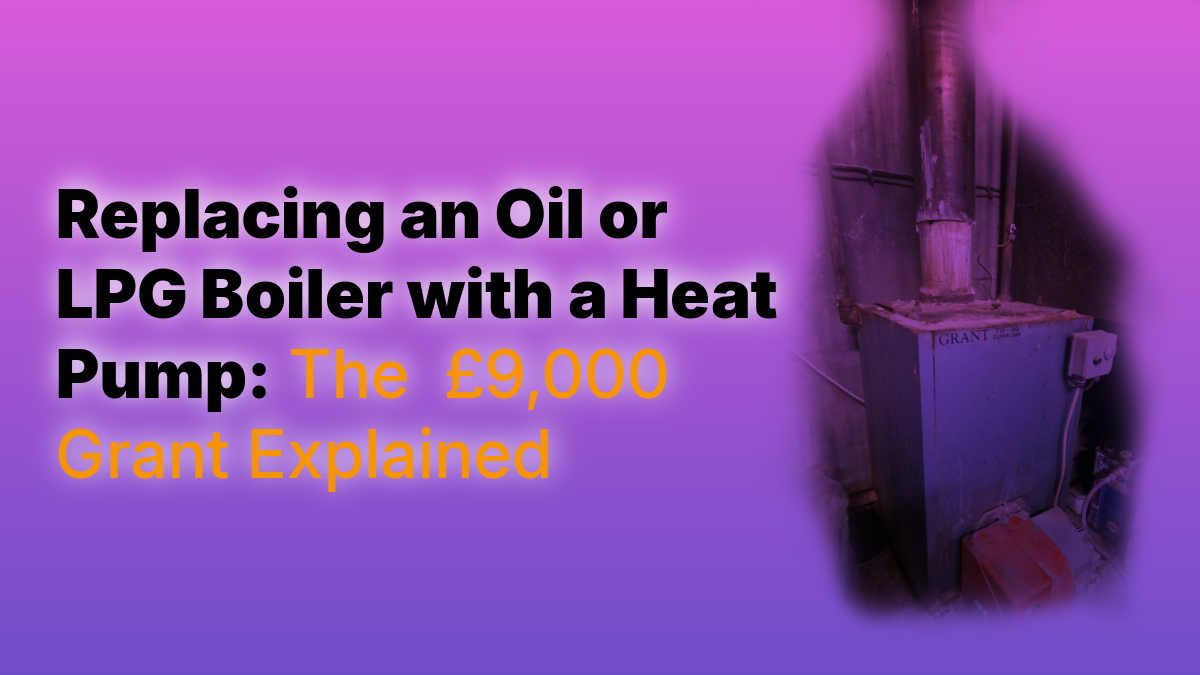
Oil and LPG heating replacement
Replace an Oil Boiler With a Heat Pump: £9,000 Grant Guide
Want to replace an oil boiler with a heat pump? Eligible off-gas-grid homes replacing oil or LPG can currently receive £9,000 towards an air-to-water or ground source heat pump—but the fuel, gas-meter history, property and proposed system must all meet Ofgem’s rules.
Rules checked against Ofgem guidance on 13 September 2026
The short answer
Can you replace an oil boiler with a heat pump using BUS?
Yes. An eligible property in England or Wales can replace an oil or LPG heating system with an air-to-water or ground source heat pump through the Boiler Upgrade Scheme.
The standard grant is £7,500. A temporary £9,000 rate applies where the property meets Ofgem’s enhanced off-gas-grid criteria. The additional £1,500 is not available merely because a home currently burns oil: its mains-gas and meter-point history also matter.
Interactive eligibility guide
Check the key £9,000 grant criteria
Answer three questions for an initial indication. This cannot replace Ofgem’s decision or the evidence submitted by your installer.
1. What heating system is being replaced?
2. Is there a mains-gas connection or a record of a gas meter point?
3. Which technology is proposed?
Enhanced grant may apply
The answers match the headline uplift criteria, subject to the property and full scheme rules.
The property must also not be connected to a heat network or be an excluded new build. A capped or clamped gas supply does not qualify as off-grid, and Ofgem makes the final decision.
Whole-system conversion
It is more than an appliance swap
An oil boiler can usually deliver high-temperature water with little regard for electrical input. A heat pump works differently, so the building, emitters, water storage, pipework and controls must be designed together.
Room-by-room heat loss
The design establishes what every room needs at the local outdoor design temperature. Floor area or the old boiler output is not a substitute.
Radiators and flow temperature
Existing emitters are checked at the proposed heat-pump temperatures. Some may remain; others may need targeted replacement.
Cylinder and recovery
Capacity, coil performance, heat-pump output and household demand determine the appropriate hot-water arrangement.
Understanding the quotation
What does an oil-to-heat-pump conversion cost?
There is no responsible universal “price after grant”. The £9,000 is a fixed contribution; the remaining price depends on what the complete property needs.
Heat pump and cylinder
Specified from calculated demand, operating temperatures, hot-water use and available space.
Emitters and pipework
Radiator, underfloor-heating, circulation and system-volume changes vary significantly between homes.
Electrical and controls
Supply arrangements, protection, wiring, weather compensation and room reference form part of the system.
Old fuel equipment
Boiler removal, remaining fuel, tank work, access and making good must be clearly allocated.
Emitters and water flow
Will every radiator need replacing?
Not necessarily. At a lower water temperature an existing radiator releases less heat, so every room should be checked against its calculated heat loss.
Some radiators may already be large enough. Others may require a larger panel, more surface area or another emitter. The correct result might be no changes, targeted upgrades or wider replacement—it should come from the calculation.
Domestic hot water
Do you need a new hot-water cylinder?
Most air-to-water heat pumps supplying domestic hot water use a cylinder. An existing cylinder should not be retained simply because it looks large enough: its coil, insulation, capacity, pressure rating and recovery performance must suit the proposed system.
Selection should reflect actual baths, showers, occupancy, simultaneous demand and recovery—not bedroom count alone.
Existing fuel system
What happens to the oil tank or LPG supply?
The quotation should state who deals with remaining fuel, the boiler and fuel line, tank or cylinders, making good and any landscaping.
An oil tank may be emptied, cleaned, decommissioned or removed depending on condition, access and scope. LPG cylinders or a bulk tank may belong to the fuel supplier, so collection and contract closure may sit with the customer.
Bills and performance
Will a heat pump cost less to run than oil?
Sometimes—but no honest installer can answer from the fuel name alone.
| Factor | Why it changes the comparison | What a proposal should show |
|---|---|---|
| Existing oil use | Delivered fuel, boiler efficiency and hot-water use determine the useful heat currently bought. | Annual consumption and a stated efficiency assumption. |
| Heat-pump efficiency | Seasonal performance changes with outdoor temperature, flow temperature, hot water and controls. | A design-based seasonal estimate, not only a brochure COP. |
| Energy prices | Oil and electricity prices vary; tariff choice can materially affect the result. | Visible unit-rate assumptions and sensitivity. |
| Heat demand | Fabric, occupancy and comfort settings affect both systems. | Calculated design heat loss plus a reasoned annual-demand estimate. |
From assessment to handover
The practical oil-to-heat-pump journey
Select each stage to see what should happen.
Protect the evidence
Record the existing oil or LPG system
Before removal, retain photographs, fuel bills or receipts, model details and any available EPC reference. Evidence is particularly important where no valid EPC exists or the enhanced grant is being claimed.
Technical design
Calculate the home, then specify the system
Complete the room-by-room heat loss, emitter review, hydraulic design, hot-water assessment, electrical review, noise assessment and control strategy.
Scope and approval
See the complete work and grant deduction
The proposal should identify inclusions, exclusions, equipment and payment stages. The installer applies to Ofgem; the property owner responds to Ofgem’s consent request.
Managed transition
Coordinate heating, fuel and electrical work
The programme should minimise loss of heating and hot water while coordinating the old boiler and fuel system, new heat pump, cylinder, emitters, pipework and electrical work.
Performance begins here
Commission, explain and document
Flow rates, weather compensation, hot-water settings, controls and emitters must be commissioned. The customer should receive operating guidance, certificates, warranties and the documented design.
Common questions
Oil boiler replacement grant FAQs
Does the £9,000 grant apply to LPG as well as heating oil?
Yes. The enhanced rate includes qualifying off-gas-grid properties replacing oil or LPG with an eligible air-to-water or ground source heat pump.
Can coal or direct electric heating receive £9,000?
No. Those fuels can potentially meet the standard scheme’s existing-heating requirement, but Ofgem restricts the enhanced £9,000 rate to qualifying oil and LPG replacements.
Can I qualify by disconnecting or capping mains gas?
No. Ofgem says a capped or clamped gas meter point is still treated as mains-gas fuelled for the enhanced grant. A record of an existing gas meter point also prevents the property meeting the uplift definition.
Do I need a valid EPC?
Since 28 April 2026, a valid EPC is no longer mandatory. If one exists, its number must be provided. Without one, alternative evidence about the energy supply and existing heating is required.
Can I keep the oil boiler as backup?
BUS does not support a hybrid system combining a fossil-fuel boiler with a heat pump. The heat pump must satisfy the scheme’s full space-heating requirements.
Is the £9,000 grant means tested?
No income test is stated. Eligibility depends on the property, fuel, proposed technology, ownership, installer and the other scheme requirements.
How long is the BUS voucher valid?
An approved air-source project normally has three months to complete installation. Ground-source projects normally have six months.
Does £9,000 cover the whole conversion?
Not necessarily. It is a fixed contribution deducted from the eligible installation price. The customer pays the remaining balance for the agreed complete scope.
Authoritative guidance
Check the official scheme rules
Ofgem administers BUS and its current guidance takes precedence over installer articles. Enhanced-grant dates and evidence requirements can change.
Start with the property
Could your oil- or LPG-heated home qualify?
Enerus can review the evidence, calculate the property’s heat loss and explain the complete conversion before preparing a fixed proposal.