
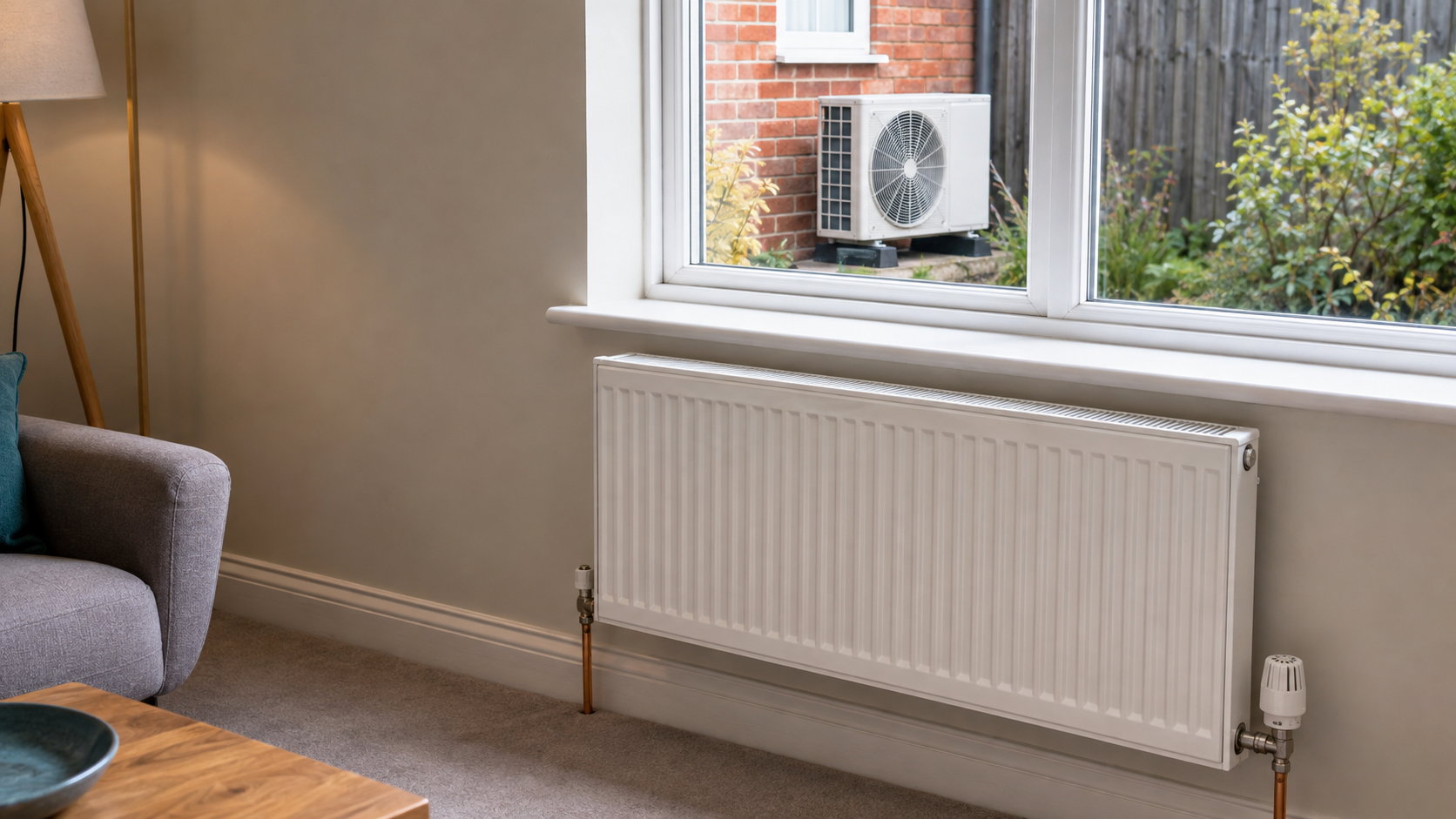
Can You Use Existing Radiators With a Heat Pump?#
Yes—many existing radiators can work with an air source heat pump. You do not automatically need to replace every radiator in the house.
The correct answer depends on three things: how much heat each room loses, how much heat its radiator can deliver at the proposed water temperature, and whether the existing pipework can carry the required flow. A proper heat-pump design checks all three room by room. Some homes keep most of their radiators, while others need selected upgrades.
The short answer
- Existing radiators can often be retained if they are large enough for the room.
- Heat pumps usually run radiators at a lower water temperature than traditional boilers.
- A radiator releases less heat when the water inside it is cooler.
- The decision should be based on a room-by-room heat-loss calculation—not appearance, age or guesswork.
- Larger radiators, fan-assisted emitters or underfloor heating may be recommended in rooms where the existing output is insufficient.
Why do radiators behave differently with a heat pump?#
A gas or oil boiler can send relatively hot water through the heating circuit and bring radiators up to temperature quickly. A heat pump is different. It normally performs best when it supplies steadier heat for longer periods at the lowest practical flow temperature.
That does not mean the radiators must feel cold. They will usually feel warm rather than fiercely hot, and the home should maintain a more even temperature instead of moving repeatedly between hot and cool.
The important point is that a radiator’s output changes with water temperature. The cooler the radiator is compared with the room, the less heat it releases. Therefore, a radiator that comfortably heats a room on a high-temperature boiler system may—or may not—have enough output on a lower-temperature heat-pump system.
This is why simply swapping a boiler for a heat pump without assessing the emitters can lead to disappointing results.
Will all my radiators need replacing?#
Usually not. There are three common outcomes after a proper survey:
| Survey result | Likely recommendation |
|---|---|
| Existing radiator output exceeds the room heat loss at the design temperature | Keep the radiator |
| Output is close but not quite sufficient | Consider a modestly larger or higher-output radiator |
| Output is well below the room requirement | Upgrade the emitter, improve the building fabric or review the system design |
It is quite normal for the answer to vary around one property. A large double-panel radiator in a lounge may be suitable, while a small single-panel radiator in a north-facing bedroom needs replacing. Property age alone does not provide the answer.
How an installer decides which radiators can stay#
1. Calculate the heat loss of every room#
The first step is to calculate how much heat each room needs on a cold design day. This is expressed in watts.
The calculation considers room dimensions, walls, floors, ceilings, windows, doors, insulation, ventilation and the temperature the room needs to maintain. The official MCS heat-load methodology requires heated spaces and their building elements to be entered individually so the load is not reduced to a rough whole-house estimate.
Enerus offers a professional room-by-room heat-loss survey and includes this detailed design work within its heat-pump installation process.
2. Identify the existing radiator#
The survey records each radiator’s height, width and type. A single-panel radiator has a very different output from a double-panel, double-convector radiator of the same face size.
A sound, correctly sized existing radiator can remain in service. Corrosion, damaged fins, cold spots or heavy internal sludge may justify remedial work or replacement.
3. Recalculate its output at the proposed temperatures#
Radiator catalogues commonly quote output at ΔT50. This means the difference between the radiator’s average water temperature and the room temperature is 50°C. A lower-temperature heating system has a smaller difference, so the quoted output must be corrected.
For example, Stelrad’s published factors show that a radiator delivers about 51% of its quoted ΔT50 output at ΔT30. At ΔT20, the factor is about 30%. These figures illustrate why the temperature used in the design matters so much; the correct factor and output must be checked for the actual emitter and design conditions.
| Operating difference | Approximate proportion of quoted ΔT50 output* |
| ΔT50 | 100% |
| ΔT40 | 75% |
| ΔT30 | 51% |
| ΔT20 | 30% |
*Based on Stelrad’s published radiator correction factors. This is an output illustration, not a design recommendation.
4. Check the pipework and flow#
Radiator size is only part of the system. A heat pump must move enough water around the circuit to transfer the required heat.
Existing small-bore or microbore pipework is not an automatic rejection, but its lengths, arrangement, resistance and required flow rate need to be assessed. The Energy Saving Trust identifies radiator sizing, narrow-bore pipework and pipe insulation among the details that have caused problems in poor-quality installations historically.
A good design checks the whole circuit: pipe diameters, valves, pumps, system volume, water quality and balancing—not only the outdoor unit.
Which existing radiators are most likely to work?#
The following are positive signs, although none replaces a calculation:
- The radiator was already oversized for the room.
- It is a modern double-panel convector radiator with a relatively high output.
- The room has been insulated, draught-proofed or fitted with improved glazing since the radiator was installed.
- The current boiler heats the room comfortably with its flow temperature turned down.
- There is generous wall space if only a small size increase is needed.
A low-temperature boiler test during colder weather can indicate how the house responds, but weather, controls and balancing affect the result. It does not replace a design calculation.
When are radiator upgrades more likely?#
An upgrade may be needed where:
- A radiator is small, single-panel or has limited convector area.
- The room has several external surfaces, large windows or high ceilings.
- The existing emitter only just manages at a high boiler temperature.
- A bathroom relies on a decorative towel rail with limited output.
- The design is targeting a lower flow temperature to improve seasonal efficiency.
- The existing radiator or valves are in poor condition.
What are the alternatives to a much larger radiator?#
A higher-output radiator#
Moving from a single-panel radiator to a double-panel, double-convector model can increase output without making the radiator dramatically wider.
A fan-assisted emitter#
Fan convectors use quiet, low-power fans to move more air across the heat exchanger. They can provide useful output from a compact unit, although they add electrical components and may not suit everyone aesthetically.
Underfloor heating#
Water-based underfloor heating offers a large heat-emitting area and can work efficiently at lower water temperatures. It can be particularly attractive during a renovation, extension or floor replacement, but it is not necessary in every heat-pump home.
Fabric improvements#
Reducing a room’s heat loss can allow a smaller emitter to meet demand. Loft insulation, cavity-wall insulation, improved glazing and draught reduction may all help where appropriate. The value of each measure depends on the property and should be assessed on its own merits.
Is a high-temperature heat pump the answer?#
Modern heat pumps can often achieve higher water temperatures, which helps in difficult retrofits. But a heat pump generally works harder as the required water temperature rises. The design should balance radiator changes, building heat loss, pipework, cost and predicted performance rather than depending on a high setting to compensate for undersized emitters.
Enerus design view
We do not decide how many radiators to replace before calculating the property. Every room is checked against its own heat loss and the proposed system temperatures. If an existing radiator can deliver the required output, retaining it can reduce disruption and cost. If it cannot, we show the upgrade in the design rather than hoping a higher heat-pump setting will compensate later.
How much grant support is available in 2026?#
As checked on 7 August 2026, the Boiler Upgrade Scheme provides £7,500 towards an eligible air-to-water heat pump in England and Wales. Eligible off-gas-grid properties replacing oil or LPG can receive £9,000 until 31 March 2027. The scheme is installer-led, and an MCS-certified installer applies on the property owner’s behalf.
Read Enerus’s Boiler Upgrade Scheme guide or check the current rules directly with Ofgem. Confirm eligibility and grant value before work begins.
The bottom line#
You can often use existing radiators with a heat pump. The honest answer comes from calculating each room’s heat loss, checking radiator output at the intended water temperature and confirming the pipework can support the required flow.
Enerus designs and installs air source heat pumps across County Durham, Northumberland, Tyne and Wear, Teesside and the wider North East. Every proposal starts with proper assessment rather than a blanket assumption that all radiators must stay—or all must go.
To find out what your own home needs, book a free heat-pump home assessment or contact Enerus on 01740 669 585.
Frequently asked questions#
Do heat pumps need special radiators?#
No. Heat pumps can use ordinary wet central-heating radiators when those radiators provide enough output at the system’s design temperatures. Some rooms may need larger panel radiators or another emitter type.
Can a heat pump use old cast-iron radiators?#
Potentially. Cast-iron radiators have a large water volume and can provide useful output, but the actual model, size, condition and room requirement must be assessed. The system may also need cleaning and hydraulic checks.
Will my radiators feel colder with a heat pump?#
They will often feel less hot than radiators on a boiler system because a heat pump commonly supplies lower-temperature water for longer periods. Correctly sized emitters should still keep the room comfortable.
Can heat pumps work with microbore pipes?#
Sometimes. Microbore is not automatically incompatible, but the installer must check pipe lengths, resistance, flow requirements and circuit layout. Some sections may need alteration if they cannot carry the required flow.
Is underfloor heating essential for a heat pump?#
No. Underfloor heating is a good low-temperature emitter, but a correctly designed radiator system can also work very well. The best solution depends on the property and the scope of the project.
How will I know which radiators Enerus plans to replace?#
The room-by-room design compares each room’s calculated heat loss with the output of its proposed emitter. Any retained or upgraded radiators should be identified in the system design and quotation before installation.
Helpful links#
- Air source heat pumps
- Heat-loss survey
- Air source heat-pump installer technical assessment
- Underfloor heating
- Boiler Upgrade Scheme guide
- Contact Enerus
Authoritative sources checked#
- MCS Heat Load Calculator: room data requirements
- MCS Heat Load Calculator: room-detail guidance
- Energy Saving Trust: heat-pump questions answered
- Energy Saving Trust: domestic heat-pump best-practice guide
- Stelrad: radiator correction factors
- Ofgem: Boiler Upgrade Scheme
- GOV.UK: Boiler Upgrade Scheme grant values effective from 21 July 2026