
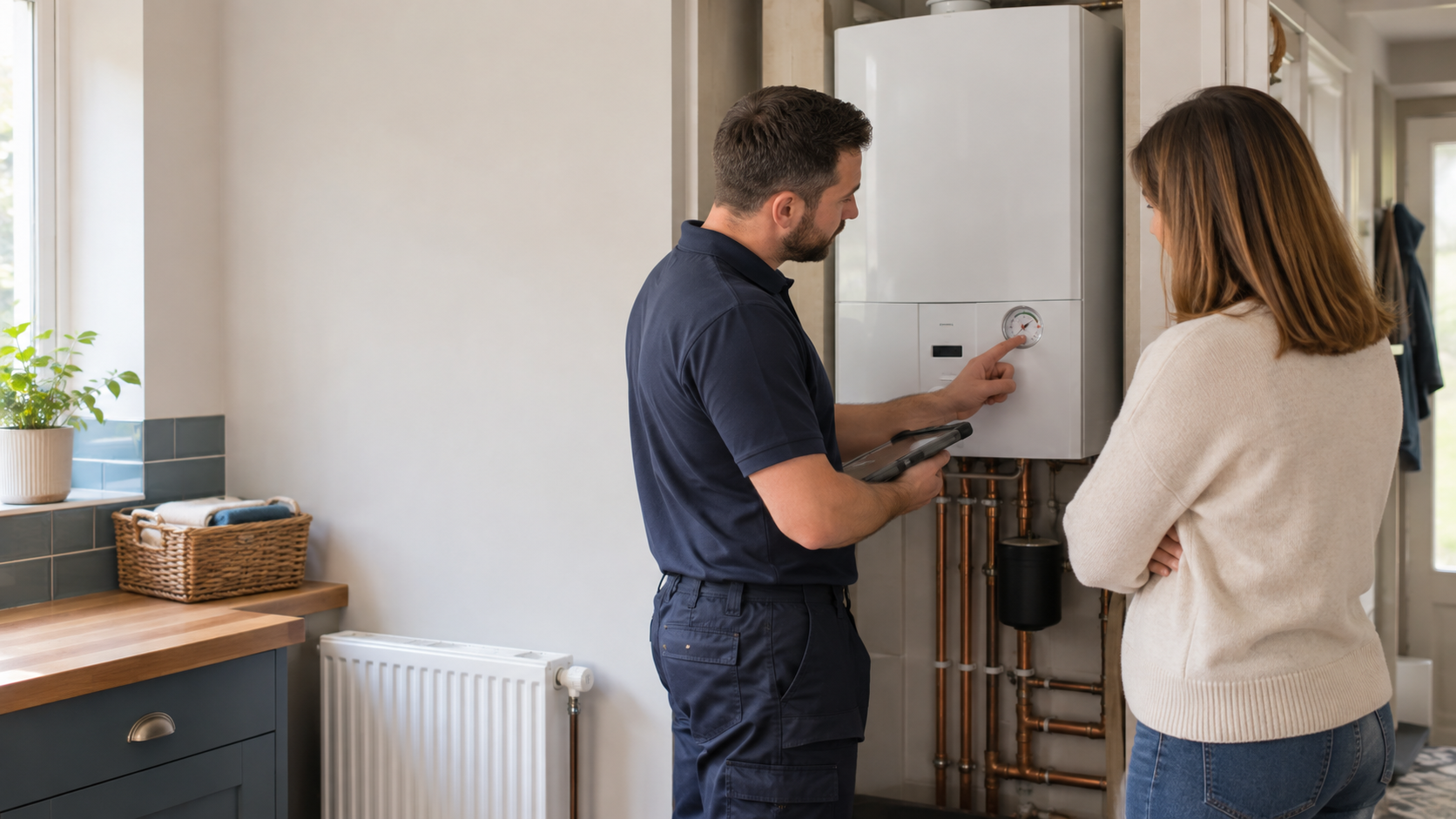
Boiler Pressure Keeps Dropping? Causes and Safe Checks
If your boiler pressure keeps dropping, water is probably leaving the sealed heating circuit or an internal component is no longer managing pressure correctly. A one-off drop after bleeding a radiator may only need model-specific repressurisation. If the pressure falls again, rises sharply when the heating runs, or there is visible water, stop repeatedly topping it up and arrange a proper diagnosis.
What does boiler pressure actually mean?
The number on the gauge is the water pressure inside a sealed central-heating circuit. It is not the pressure of the gas supply and it is not the same as the mains-water pressure at your taps. Your boiler needs the heating circuit to stay within the operating range specified by its manufacturer.
Many sealed systems sit at roughly 1 to 1.5 bar when cold, but that is only a general guide. The correct cold pressure and filling method depend on the boiler and installation, so use the appliance manual or the marking on its gauge. Some older open-vented systems work differently and may not have a user pressure gauge at all.
Do not treat regular topping-up as routine maintenance. Adding fresh water can restore pressure temporarily, but it does not repair the cause. It also dilutes the corrosion inhibitor protecting the system. If you need to refill repeatedly, the next step is fault-finding.
Why boiler pressure keeps dropping
Pressure loss is a symptom rather than a complete diagnosis. These are the main possibilities an engineer will consider alongside the pattern you report.
A leak in the heating system
A small weep at a radiator valve, pipe joint, towel rail or hidden pipe can gradually reduce pressure. Look for staining, corrosion, lifted flooring or damp marks—without dismantling anything.
Recent radiator bleeding
Releasing trapped air also reduces system pressure. One careful refill may be expected afterwards. Continued loss means radiator bleeding was not the whole explanation.
An expansion-vessel problem
The vessel absorbs the water’s expansion as it heats. If it loses its air charge or its diaphragm fails, pressure may climb unusually high while hot and fall very low after cooling.
A passing pressure-relief valve
If system pressure becomes excessive, the safety valve can discharge water outside. A valve may then continue to pass. Water or staining at the external discharge pipe is useful evidence for the engineer.
A leak inside the boiler
Seals, automatic air vents and other components can leak. Water may not be obvious outside the case, so the absence of a visible radiator leak does not rule out pressure loss.
A gauge or sensor issue
Less commonly, the displayed pressure may not reflect the system accurately. An engineer can compare readings and assess the controls rather than replacing parts by guesswork.
What pattern are you seeing?
Select the closest match. This cannot diagnose the boiler, but it will help you decide what to record and whether a repair should be arranged.
Safe checks before booking a boiler repair
You can collect useful information without opening the boiler or carrying out gas work. This often helps an engineer understand whether the problem is constant, temperature-related or connected to a visible leak.
Record the pressure cold and hot
Note the reading before the heating starts, then again after it has been running. Take a photo if helpful. A sharp rise followed by a low reading after cooling is particularly useful diagnostic information.
Look around accessible joints
Check radiator valves, visible pipe joints and ceilings below pipe routes for drips, rust or staining. Do not remove covers, lift floors or touch a hot external discharge pipe.
Check what changed recently
Tell the engineer about radiator bleeding, a new radiator, recent plumbing work or a previously overfilled system. Timing can narrow the investigation.
Write down the model and fault code
The target pressure and filling arrangement vary by model. Record the boiler make, model, display message and how often you have added water.
Should I repressurise the boiler myself?
If the manufacturer’s instructions clearly describe a user filling procedure, there is no visible leak and the pressure dropped for an understandable one-off reason, you may be able to return it to the stated cold range. Filling loops differ: some have two valves, some use a key and others use an integrated lever. Never copy instructions for a different appliance.
Keep the gauge visible, stop at the pressure specified in the manual and make sure every filling control is fully closed. Do not leave a detachable filling hose permanently connected unless the system has been designed and instructed that way. If you cannot identify the controls confidently, the gauge does not respond normally or the pressure falls again, stop and seek help.
Do not open the boiler casing, recharge an expansion vessel or operate a safety valve as a DIY test. Repeated resetting and refilling can obscure the evidence and introduce more oxygenated water into the system. Book professional boiler fault-finding instead.
What different pressure patterns can suggest
| What you notice | Possible explanation | Sensible next step |
|---|---|---|
| One drop after bleeding radiators | Air and some system pressure were released | Follow the exact model manual once, then monitor |
| Slow fall over weeks | A small system or internal leak may be present | Record readings and inspect accessible joints; arrange diagnosis if it repeats |
| Large rise when hot, low again when cold | Expansion control or pressure-relief discharge may be involved | Stop regular refilling and book an engineer |
| Pressure falls within hours | A more significant leak or appliance fault is possible | Turn heating off if water is escaping and seek prompt help |
| No visible leak but pressure still falls | Hidden pipework or an internal component may be responsible | Professional testing is needed; do not assume there is no leak |
Boiler pressure problems in North East homes
The same fault can be harder to trace in one property than another. Older terraces in Newcastle, Sunderland and Gateshead may have pipework altered over several decades, sometimes beneath suspended floors. Rural renovations across County Durham and Northumberland can combine long pipe runs, extensions and mixed-age radiators. Newer estates can still develop a small valve leak or appliance fault.
Property type is context, not a diagnosis. Enerus can assess the pressure behaviour, visible heating system and boiler together across the North East, subject to postcode and availability. The aim is to find why water is being lost or discharged—not simply refill the system and leave the cause unresolved.
Do I need a boiler repair or a boiler service?
A routine boiler service is planned maintenance. It includes safety and operating checks, but it is not a substitute for investigating an active fault. If pressure is repeatedly falling, tell Enerus when booking so the appointment can be treated as a diagnostic repair rather than a standard annual service.
If the boiler is older and pressure loss sits alongside repeated breakdowns, obsolete parts or corrosion, it may be sensible to compare repair with a planned replacement. Age alone does not decide it: read how long boilers typically last and review new boiler options only after the present problem has been assessed.
Boiler pressure FAQs
How often should I need to top up boiler pressure?
A sealed system should normally hold pressure. A one-off refill after radiator bleeding or approved maintenance can be understandable. Needing to add water regularly—especially every few days—is evidence that the cause should be investigated.
Can a boiler lose pressure without a visible leak?
Yes. A leak may be beneath flooring, inside a wall, at the external discharge pipe or within the boiler. Small losses can also evaporate on hot components. An engineer may need to separate and test parts of the system.
Why does pressure rise when my heating comes on?
Some rise is normal as water warms and expands. A large rise towards the upper end of the gauge, followed by very low pressure after cooling, can indicate that expansion is not being accommodated correctly. Record both readings for the engineer.
Will low pressure leave me with no heating or hot water?
It can. Many boilers stop or display a fault when pressure falls outside their operating range. Other faults can produce similar symptoms, so record the gauge and code. Our guide to no hot water when the heating still works helps separate another common pattern.
Can I use leak-sealing liquid instead of repairing the leak?
Do not add chemicals without a competent assessment. The correct response depends on the size and location of the leak, system condition and manufacturer requirements. A sealant is not a universal substitute for repairing a failed joint or component.
What if I smell gas or suspect the boiler is unsafe?
Do not use the appliance. Open doors and windows, avoid flames and electrical switches, turn off the gas at the meter only if you know how to do so safely, and call the National Gas Emergency Service on 0800 111 999. Pressure loss alone is usually a heating-water issue, but any suspected gas problem takes priority.
Book a boiler pressure diagnosis with Enerus
Tell us the cold and hot readings, how quickly the pressure falls, any visible water and the boiler’s make, model and fault code. Enerus will use that information to arrange the appropriate next step for your North East home.
Coverage and appointment availability depend on postcode. If you suspect a gas emergency, call 0800 111 999 rather than using the standard booking route.