
Heat-pump design guide
Do Heat Pumps Need New Radiators?
If you are considering an air source heat pump, you may have heard that every radiator must be replaced. You may also have been told that none of them needs changing. Neither blanket answer is reliable.
Short answer: heat pumps do not automatically need new radiators. Each existing radiator should be checked against the calculated heat loss of its room at the water temperature proposed for the new system. Some may already be large enough; others may need a targeted upgrade.
Why do heat pumps need different radiator checks?
A gas or oil boiler is often operated with hotter water than a heat pump. A radiator gives out less heat as the difference between its water temperature and the room temperature becomes smaller. That does not make ordinary radiators incompatible with heat pumps. It means their output must be assessed at the proposed operating temperatures, not copied from a catalogue figure based on different conditions.
The design question is simple: on a cold day, can each emitter replace the heat its room is losing while the heat pump works at a sensible flow temperature? Answering it properly requires two sets of information: a room-by-room heat-loss calculation and the output of each existing or proposed emitter at the design temperatures.
The key point: whole-house heat loss sizes the heat pump; room heat loss checks the radiators. One total figure cannot show whether the living room is comfortable while a north-facing bedroom struggles.
Do heat pumps need new radiators in every room?
Yes. Standard steel panel radiators can work well with an air source heat pump when their available output matches the room requirement. A radiator may have spare capacity because it was generously sized, the property has since been insulated, a window has been replaced, or the room no longer loses as much heat as it once did.
That is why a good design may keep some radiators and change others. A correctly designed low-temperature system may leave radiators feeling warm rather than very hot while still maintaining the chosen room temperature over a longer operating period.
Likely to stay
An existing radiator whose verified output meets the room load at the proposed design temperatures.
May need upgrading
A small or low-output emitter in a room with a higher calculated loss, such as an exposed lounge or bathroom.
Needs investigation
An unidentified radiator, restricted pipework or a proposal that does not state its flow-temperature assumptions.
Check the radiator evidence in your heat-pump quote
Tick each item your survey or written proposal provides. This does not size your radiators; it shows whether the recommendation is supported by useful design evidence.
What radiator upgrades might a heat pump need?
Where an existing emitter falls short, replacement is only one option. The designer may be able to use a longer or taller radiator, a deeper panel with more convector surface, a second emitter, fan-assisted equipment or underfloor heating. Improving insulation can also reduce the room load, although fabric work should be assessed on its own merits and reflected in the calculation.
| Situation | What the design should check | Possible outcome |
|---|---|---|
| Large existing double-panel radiator | Verified size and output against the room heat loss at the chosen water temperatures | It may remain unchanged if the figures work |
| Small radiator in an exposed room | External walls, glazing, ventilation loss and available wall space | A larger or higher-output emitter may be specified |
| Bathroom with a towel rail | Whether the rail can meet the bathroom’s design load at lower water temperatures | A larger rail or supplementary emitter may be appropriate |
| Extension with underfloor heating | Floor construction, heated area, pipe layout and required room output | Existing floor circuits may work, need adjustment or require supplementary heat |
The best option is not always the physically largest radiator. Wall space, furniture, doors, comfort, appearance, pipe routes and the effect on the system’s overall design temperature all matter. A clear proposal should show the chosen solution rather than use a generic allowance.
Why heat-pump flow temperature matters
Flow temperature is the temperature of water leaving the heat pump for the heating system. In general, lower operating temperatures help a heat pump work more efficiently, but the emitters still have to deliver enough heat. The design therefore balances radiator capacity, pipework and comfort with the heat pump’s intended performance.
Raising the proposed flow temperature can increase radiator output, but it should not be used to hide inadequate emitter design. Equally, specifying unnecessarily large radiator changes simply to chase the lowest possible temperature may add cost and disruption without being the best overall choice. The sensible target is a coherent system that can heat the home at its design condition and operate efficiently through the season.
It is not only about radiator size
Radiator output is important, but the heating water must also reach every emitter at the required flow. A competent survey should consider the wider system rather than treating radiator swaps as the entire conversion.
- Pipework: diameter, layout, condition and restrictions influence the flow available around the system. Microbore pipe is not an automatic rejection, but it needs assessment.
- Valves and controls: the proposed control strategy should allow the heat pump to operate steadily without rooms fighting the central control.
- Balancing: commissioning should distribute flow so nearby radiators do not take more than their share while distant rooms remain cool.
- Water quality: existing systems may need cleaning, protection and suitable filtration as part of the agreed installation design.
- Available space: if a larger panel will not fit, the designer should discuss another emitter or a different approach.
This whole-system approach is central to Enerus’s air source heat-pump design and installation service.
Three practical room-by-room examples
Insulated semi-detached home
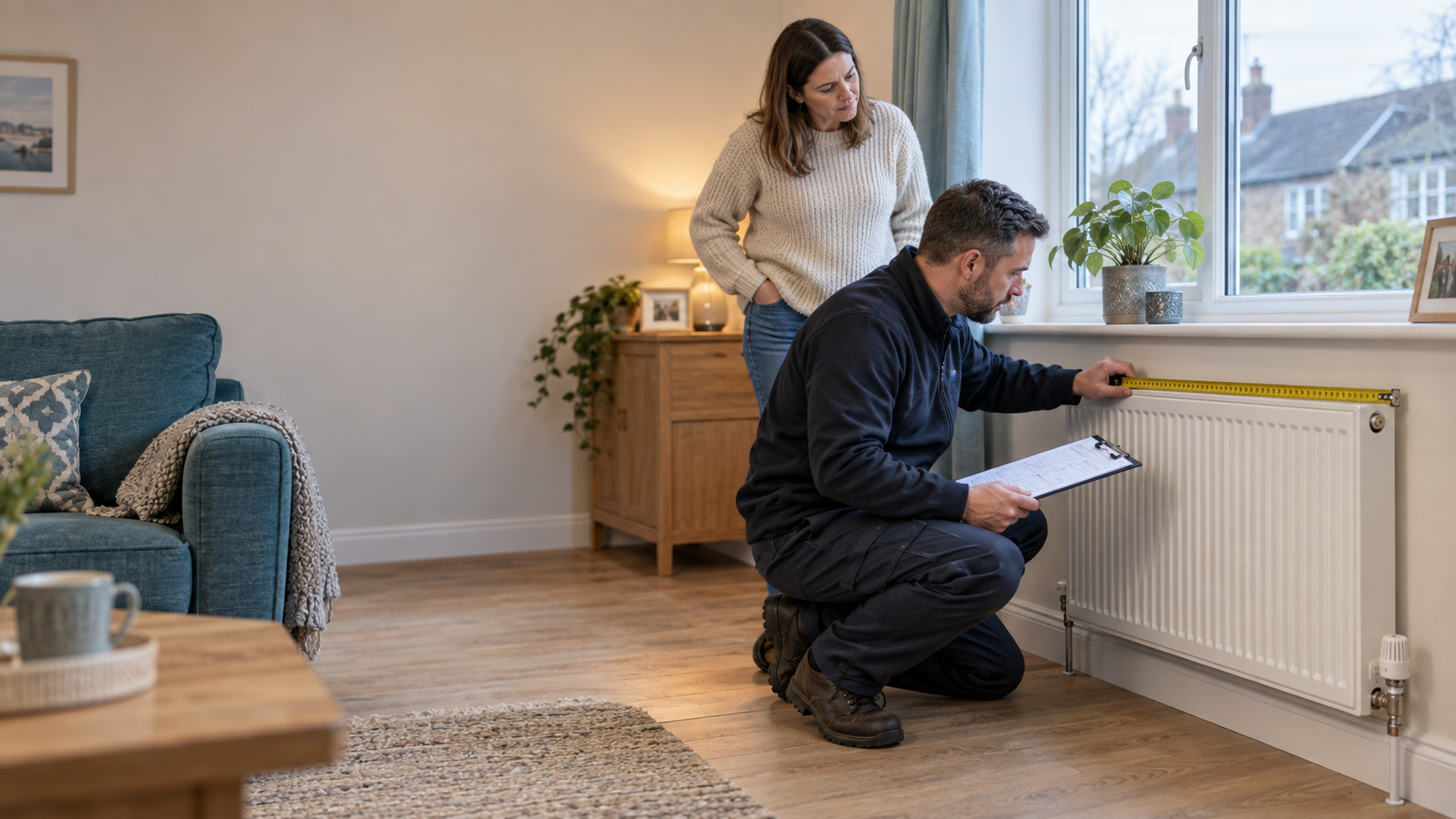
A living-room radiator installed for an older, leakier version of the house may have useful spare capacity after loft insulation and glazing improvements. The calculation could justify keeping it, while a small bathroom rail still needs attention.
Traditional stone property
A room with solid external walls and greater exposure may have a higher design loss than a similar-sized internal room. The proposal might retain bedroom radiators but specify more emitter area in the main living space.
Mixed old and new system
A house extended over time may contain several radiator types and pipe sizes. Recording them individually avoids replacing newer suitable emitters merely because older ones elsewhere are undersized.
Radiator design for North East homes
Across the North East, heating systems sit in very different buildings: Newcastle and Sunderland terraces, County Durham semis, newer Cramlington estates, Teesside bungalows and exposed stone homes in rural Northumberland. Construction, alterations and exposure can vary even between neighbouring properties.
Location matters because the design must reflect appropriate outdoor conditions, but a postcode or house age cannot decide which radiators stay. Measurements, construction assumptions, room temperatures and emitter details still need to be recorded. Enerus’s room-by-room heat-loss survey is designed to create that evidence before equipment or radiator changes are finalised.
What should your heat-pump quotation show?
Before accepting a quote, ask for a clear link between the design and the work being priced. You do not need to become a heating engineer, but you should be able to see why each material change is recommended.
- The room-by-room heat-loss results and important construction assumptions.
- The proposed design flow temperature and room temperature targets.
- A record of existing radiators or other emitters.
- The assessed emitter output under the proposed conditions.
- A room schedule identifying retained and replacement radiators.
- The exact radiator, valve, pipework and making-good work included in the price.
- Any limitations where hidden pipework or construction could not be confirmed.
Radiators are only one part of the project cost. Our air source heat-pump cost guide explains the other elements that can affect a complete installation.
Heat pump and radiator FAQs
Do I need special radiators for an air source heat pump?
No special category of radiator is automatically required. Standard panel radiators can be suitable if their calculated output meets the room heat loss at the proposed system temperatures. Where more output is needed, a larger, deeper or alternative emitter may be specified.
Will all my radiators need replacing?
Not necessarily. A room-by-room assessment may show a mixture: some radiators retained, some upgraded and perhaps one room needing a different solution. Be cautious if a recommendation to change all or none is not supported by individual room figures.
Can a heat pump work with small radiators?
Potentially, but size alone does not answer the question. Panel type, available output, room heat loss and design temperatures all matter. A small emitter in a low-loss room could be adequate, while the same radiator in an exposed room may not be.
Do I need underfloor heating with a heat pump?
No. Underfloor heating can work effectively at lower water temperatures, but a heat pump can also use correctly sized radiators or a mixed emitter system. Retrofitting underfloor heating throughout is not a universal requirement.
Can I decide by turning down my boiler temperature?
A controlled trial may reveal comfort issues, but it is not a substitute for design. Weather, boiler controls, operating time and unknown radiator outputs can distort the result. Use a room-by-room calculation for an investment decision.
Should radiators feel cooler with a heat pump?
Often, yes. Heat pumps commonly deliver steadier heat for longer rather than short bursts from very hot radiators. Comfort is judged by whether rooms maintain their target temperature, not by how hot the radiator feels to a hand.
Get a radiator answer based on your home
Enerus designs heat-pump systems around room-by-room heat loss, emitter performance and the temperatures the complete system will use. If you are planning an installation in the North East, we can help establish what can stay, what needs changing and why.